Property research • November 6, 2026
By Michael J. Fusco, Legacy Wise Advisors
Before money changes hands on a property, somebody has to answer a deceptively simple question: what does the public record actually say about this place? That's what a title search in New York does. It reads the recorded history of the property and reports what it finds — no more, no less. Here's what's in that report, and just as important, what a search is not.
What a title search shows:
1. Who owns it now — and exactly how. The search confirms the current owner of record and the vesting: how title is held, whether the deed into the current owner was properly recorded, and whether the person selling is the person the record says owns it. Breaks at this first step are more common than buyers expect, especially with estate properties and older family transfers.
2. Open mortgages and other voluntary liens. Mortgages of record that haven't been satisfied, home equity lines still open against the property, and similar recorded encumbrances the seller placed there deliberately. An old mortgage that was paid off but never formally discharged still shows — and it's the search that finds it before closing, not after.
3. Involuntary liens and judgments. Tax liens, judgment liens against an owner, mechanic's liens from unpaid contractors, and HOA or condo liens. These attach whether the current owner mentions them or not, which is precisely why the search exists.
4. Easements, restrictions, and rights of others. Recorded easements (a utility's right to cross the land, a shared driveway), deed restrictions, and covenants that run with the property. These rarely stop a sale, but they absolutely change what a buyer can do with the property afterward.
5. Pending matters: lis pendens and bankruptcies. A lis pendens tells you litigation involving the property is already filed. A bankruptcy involving an owner changes who has authority to sell and on what timeline. Both are findable in the record — if someone looks.
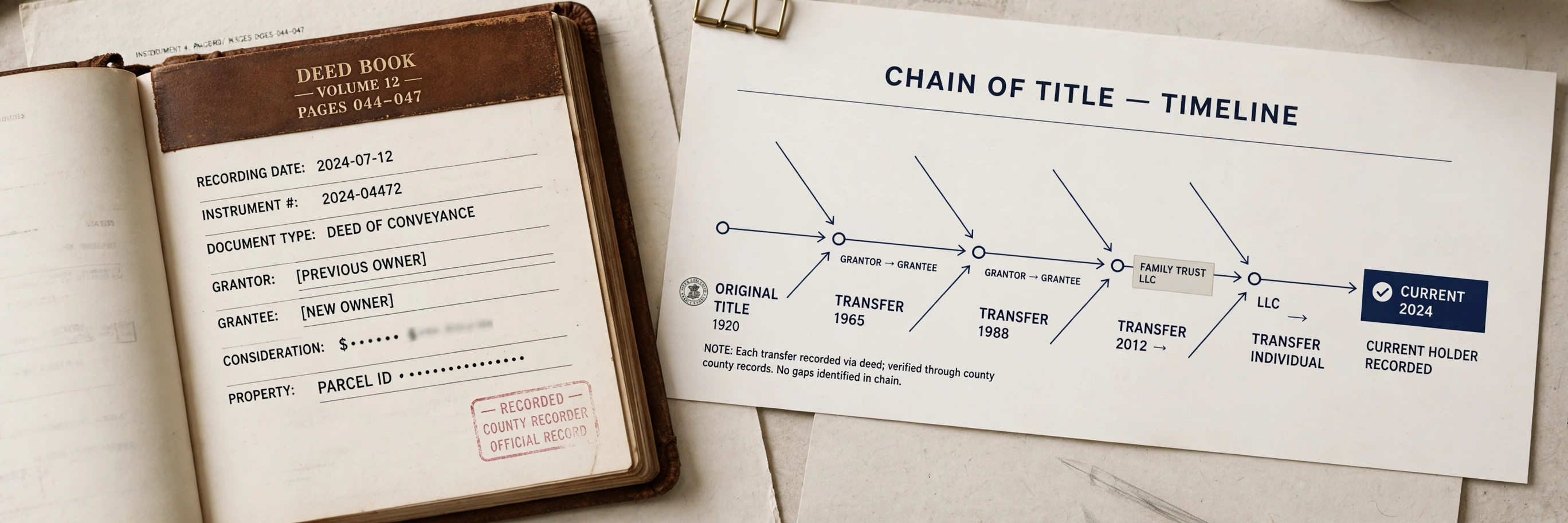
6. The chain of title itself. The search works backward, deed by deed, through prior owners for the period searched — confirming each transfer connects to the next. A gap or a defective link in that chain is the kind of problem you want discovered by a researcher in an office, not by a problem at the closing table.
Can you do one yourself? Partly, and it's worth being honest about this. New York City records are searchable through ACRIS by block and lot (the BBL), and many counties have online records. What the DIY route doesn't give you is completeness or judgment about scope: records that predate digitization, name variations that split a judgment search, off-record filings, and knowing which of New York's many search types a given transaction actually needs. Attorneys and investors order searches for the same reason anyone outsources research — the deliverable is a complete, QC'd report (our title research checklist shows the standard a finished report is checked against), not a stack of printouts. Turnaround depends on the property's age and how digitized the county's records are.
What a title search is — and is not. Please read this part.
A Legacy Wise Advisors title search is factual public-record research only. We research the record and report what it contains. We do not sell or quote title insurance, we do not imply that we hold a title insurance license, and we give no legal opinions — what a finding means for your transaction, and what to do about it, is your attorney's call. A search tells you what the record shows; it is not insurance against what the record might have missed, and it does not determine whether title is marketable or insurable.
Ordering one: Every search is priced per order and confirmed up front — you approve the cost before work begins, with no per-page surprises. Standard and rush turnaround are available across New York City, New York State, New Jersey, and Pennsylvania, with nationwide coverage on request. The same diligence mindset applies after the purchase, too — buyers taking on a renovation often pair closing research with an owner's representative to watch the project itself.
The bottom line
A title search shows you the property's recorded life: who owns it, who has claims against it, and whether the chain of ownership holds together. It's research, delivered ready for your file — and for attorneys and investors who order regularly, that reliability is the whole product.
Frequently Asked Questions
What does a title search show?
The current owner and vesting, open mortgages, tax, judgment, mechanic's and HOA liens, easements and restrictions, lis pendens and bankruptcies, and the chain of title through prior owners for the period searched.
Is a title search the same as title insurance?
No. A title search is factual research of the public record. Title insurance is a separate product that Legacy Wise does not sell or quote. A search reports what the record contains; it is not insurance against defects and includes no legal opinion.
How much does a title search cost in New York?
Every Legacy Wise search is priced per order and confirmed up front before work begins. Standard and rush turnaround are available in NY, NJ, and PA, with nationwide coverage on request.
General education only — not legal advice, and not a title opinion for any specific property.
Legacy Wise Advisors, Inc. provides title research — factual public-record research only; no title insurance is sold or quoted, and no legal opinions are offered. To request a search or open a trade account, contact (929) 244-0744 or michael@legacywiseadvisors.com.